

If you have injured your ankle and it requires a brace, then finding the right one that fits with your shoes can be a challenge.
For the most part, shoes are designed to provide a solid, comfortable fit without the presence of an ankle brace.
In addition, many ankle braces tend to be bulky and difficult to wear with a shoe present.
I’ve been there—staring at my shoes, brace in hand, wondering which one will give up first. However, the truth is, it doesn’t have to be a daily struggle.
With a few smart tricks (and the right footwear), you can walk comfortably, stay supported, and keep your ankle—and your patience—intact.
Wearing Ankle Brace with Shoes
Solving the issue of wearing an ankle brace with a shoe can be performed in three steps.
- First of all, you will need to find the right type of shoe.
- Then you must select the ankle brace that works best with the shoe.
- And finally, you will need to take the proper steps to ensure that the shoe and ankle brace work well together when you are on your feet.
Let us discuss all these steps in detail below, which will help simplify the process for you…
Choose the Right Shoes
Wearing the right pair of shoes starts with choosing a pair that is right for your feet.
Just because you need an ankle brace does not mean the need for the shoes has changed.
They must still be properly fitted, provide good support, and be comfortable if you want to maintain the health and protection of your feet.
Because you are now wearing an ankle brace, you must consider shoes that not only provide the support you need but also how they will be affected by the ankle brace, both directly and indirectly.
What kind of shoes to wear with an ankle brace?
While it may be obvious how the ankle brace affects the shoe on the same foot, you have to consider how your weight, balance, and walking will be affected by the other foot.
Your body will naturally rely more on the healthy leg to carry more weight, so you must consider that when getting the right pair of shoes.
✅ Avoid Rigid Materials: While most shoes are made with soft, flexible materials such as nylon or leather, you’ll want to avoid shoes that use rigid materials.
For example, materials such as plastics might cause even more aggravation to your ankle injury and should be avoided.
✅ Avoid Loose Materials: On the opposite end of the spectrum, you’ll want to avoid materials that are too flexible and do not provide enough support.
The purpose of the ankle brace is to keep the foot in place so the ankle can heal properly.
✅ Choose Sneakers: It’s probably not surprising that sneakers are recommended as the proper shoe when wearing a supportive ankle brace.
This is because a good pair of sneakers is made from durable, flexible materials that are designed to be comfortable.
Remember that there are differences in sneakers as they are designed for different activities. You may want to avoid running shoes as they are lightweight and designed for increased flexibility.
✅ Start with a Larger Shoe: This may sound counterintuitive initially, but an oversized shoe that still fits well around the ankle may offer the support you need while keeping your feet comfortable.
If anything, it is better to go with a shoe that is a little too large instead of one that might be too small.
You may need to experiment with different shoe sizes at this point, so start with the one that is a half-size larger than normal and go from there.
✅ Loosen the Laces: Shoes with laces are desirable because you can better set the tightness surrounding your foot. If you have suffered from a severe injury, then you’ll want to keep the laces loose so the blood flow remains good.
When it’s about picking the best shoes to wear with an ankle brace, a pair of sneakers about a half-size larger than normal with laces is generally the best place to start.
Choose the Right Ankle Brace
Ankle braces tend to be bulky, so you’ll want to select one that is slimmer and tighter while providing the same support.
Thick ankle braces only mean that you will have far more difficulty wearing the right shoes.
✅ Size: The ankle brace should be measured around your foot and not the shoe. Find the right one that fits around your foot, and you can walk comfortably without wearing shoes.
✅ Surface: A smooth, even surface is needed to wear your ankle brace with a shoe. Avoid those with uneven surfaces, flaps, and knots, which only make it more difficult.
✅ Try Different Ones: While ankle braces have the same function, they come in several different styles and brands. This means that you should rule out the braces that are too bulky, too large, and have an uneven surface.
After that, look over the ones that fit your criteria and then try them on to see how they feel. Do not get into a rush; it is okay to take your time at this stage.
Steps for Wearing the Shoes over Ankle Brace
Now that you have the right shoes and ankle brace, here are a few foot and ankle brace instructions to help you combine both comfortably.
STEP # 1. Take Away the Lower Side Strap on the Ankle Brace
This strap cannot be used when wearing shoes.
STEP # 2. Put the Strap on the Shoe
Lift the insole and put the bottom of the ankle brace inside. If you are going to wear it all day, you’ll need to put the strap in that place.
STEP # 3. Put on the Shoe
Insert your foot slowly to protect against the injury. You do not want to move the ankle brace as it supports the injury.
Once your foot is inside the shoe, tighten the laces as much as needed, secure the top strap of the ankle brace, stand up, and take a few steps.
Remember to go slowly when you first do this, as you may need to walk around all day.
It will not feel right initially, so take a few steps back and forth to get the blood flowing and spot any potential issues.
Finding the most comfortable way to wear your shoes with an ankle brace may take a few minutes, but the effort will be well worth it.
Just be sure you are as comfortable as possible before starting your day.
Do ankle braces go by shoe size?
Ankle braces generally correspond to your shoe size, but sizing can vary slightly by brand and brace type.
Most manufacturers provide a size chart based on shoe size and ankle circumference for a more accurate fit.
For best results, measure your ankle as directed—since a brace that’s too tight can restrict circulation, while a loose one won’t offer proper support.
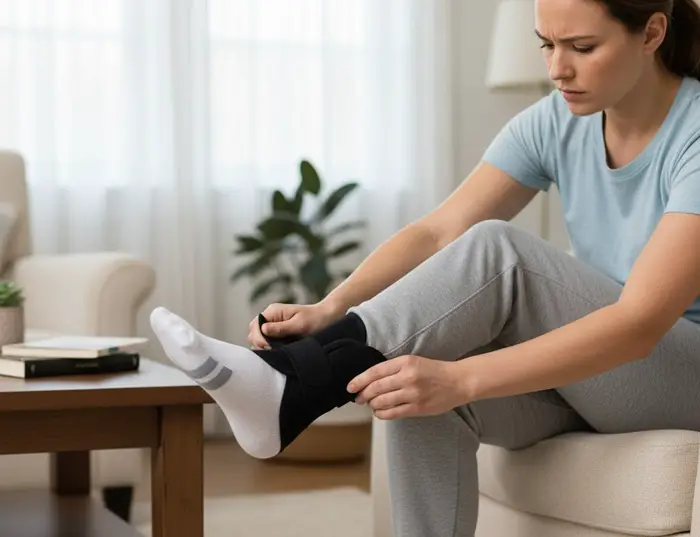
Can You Wear an Ankle Support Brace with Socks?
Yes, you can and should always wear your ankle support brace over your socks, not under. This helps prevent friction, blisters, and discomfort while maintaining proper support.
Many athletes, especially runners, often wonder whether their ankle brace should go over or under their socks when lacing up for the track. It’s a fair question — after all, the goal is to protect, not punish, your ankle.
Here’s the rule of thumb: always wear your ankle support brace over your socks, not under them. Wearing the Brace Correctly ensures optimal comfort, hygiene, and stability.
When the brace is placed directly against the skin, friction builds up during movement — leading to hot spots, blisters, and irritation, particularly around the Achilles and lateral malleolus (the bony part of your ankle).
So yes, Wear socks to prevent rubbing and unwanted chafing.
Choose high-quality, long athletic socks made of moisture-wicking fabric like nylon or polyester blends. These not only enhance comfort but also prevent sweat accumulation, which can cause slippage inside the brace.
Avoid short or ankle socks — they might look good, but offer minimal protection for your calves and tendons, especially during longer runs or high-impact training.
If you’re recovering from a sprain or simply looking to prevent one, pairing your functional ankle brace with supportive, full-length athletic socks ensures the right balance of compression, protection, and breathability — so your focus stays on your stride, not your sore ankles.
Is it OK To Wear an Ankle Brace With Shoes and Socks All Day?
Wearing an ankle brace with shoes and socks all day is generally safe and effective, but it depends on why you’re wearing it, the type of brace, and your activity level.
If it’s properly fitted, breathable, and used as intended, your brace will support your ankle all day, without replacing its natural strength.
Here’s a detailed breakdown:
When it’s okay
If you’re recovering from a mild sprain, dealing with instability, or need extra support during sports or long work hours, wearing your ankle brace all day can help prevent re-injury and provide confidence in movement.
Modern braces are designed with breathable, lightweight materials that allow air circulation and minimize sweating, making them comfortable for extended wear.
Wearing the brace over long, moisture-wicking socks also helps prevent skin irritation and friction, ensuring your feet stay dry and comfortable throughout the day.
Always choose well-fitting shoes with enough room to accommodate the brace without compressing your foot.
When to be cautious
Wearing an ankle brace continuously—especially a rigid or high-compression type—can lead to muscle dependency over time.
Your ankle muscles and ligaments may weaken if they rely too much on external support instead of engaging naturally.
To avoid this, use the brace primarily during activity, and give your ankle some time to move freely at home or during rest periods.
Also, if you notice numbness, tingling, swelling, or redness, the brace might be too tight or worn for too long. Always loosen it, check your circulation, and consult a physiotherapist if discomfort persists.
Best practice for wearing an ankle brace with shoes and socks
- Wear the brace over socks to prevent rubbing.
- Remove it periodically to stretch and let your skin breathe.
- Clean the brace regularly to maintain hygiene and material integrity.
- Follow your doctor’s advice if using it for injury recovery or chronic instability.
Final Thoughts
Wearing an ankle brace with your shoes doesn’t have to feel awkward or uncomfortable—it’s all about fit, layering, and balance.
Always start with a moisture-wicking long sock to protect your skin and reduce friction. Then, wear the brace snugly (not tightly) over the sock, ensuring even compression around the joint. Finally, choose supportive shoes with a roomy toe box and adjustable laces or straps to accommodate the brace comfortably.
Remember, the goal is to stabilize your ankle while allowing enough mobility for natural movement. Whether you’re recovering from an injury or preventing one, proper wear makes all the difference between effective support and unnecessary strain.
So, next time you gear up for a run, workout, or busy day, take a minute to put your brace on right—it’s a small effort that keeps your steps stronger, safer, and pain-free in the long run.

If you’ve ever finished a run only to feel that dull, nagging ache around your Read more

It is disheartening to reveal that foot and ankle pain in children can keep them Read more
The risk of the ankle getting injured has been common among basketball players. Fortunately, an Read more
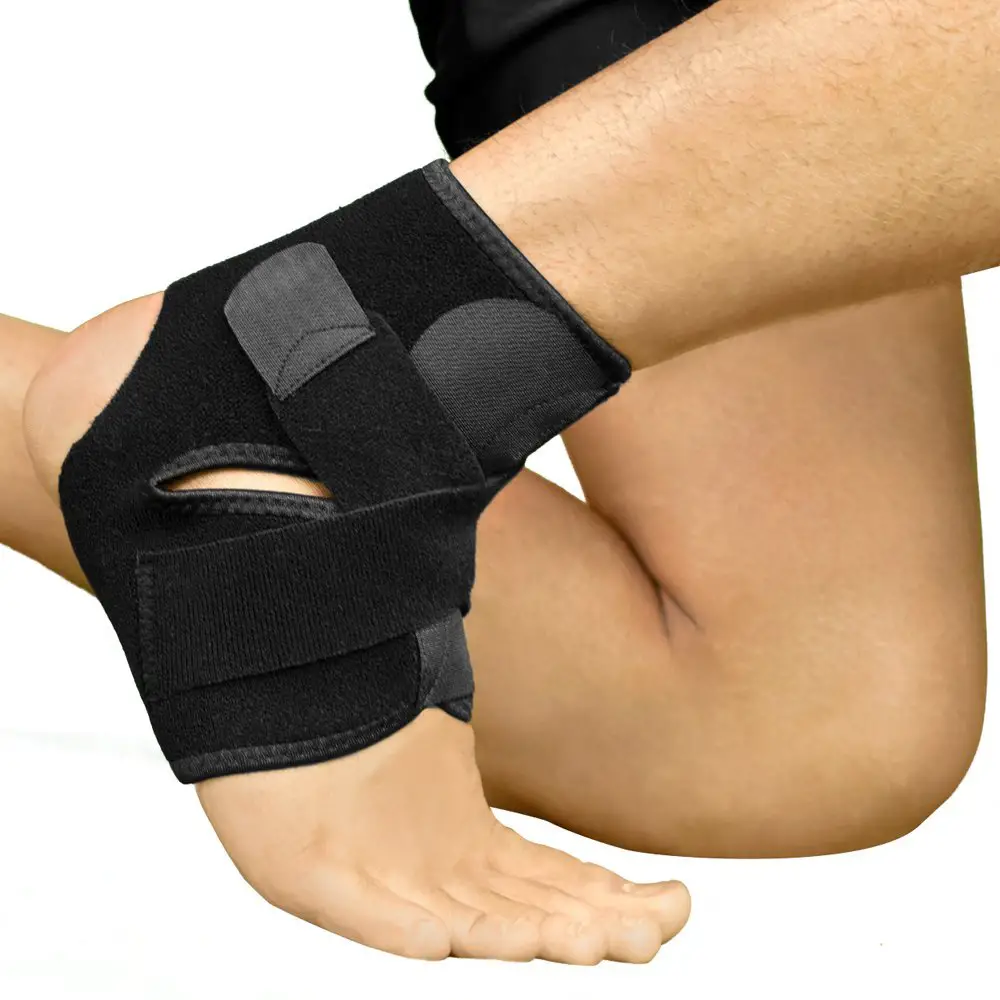
An ankle sprain is the most common issue that athletes (as well as common people Read more